Can your mattress
score every breathing pause?
A thin strip under the mattress scores breathing events overnight — then builds an AHI — without wires on the body.

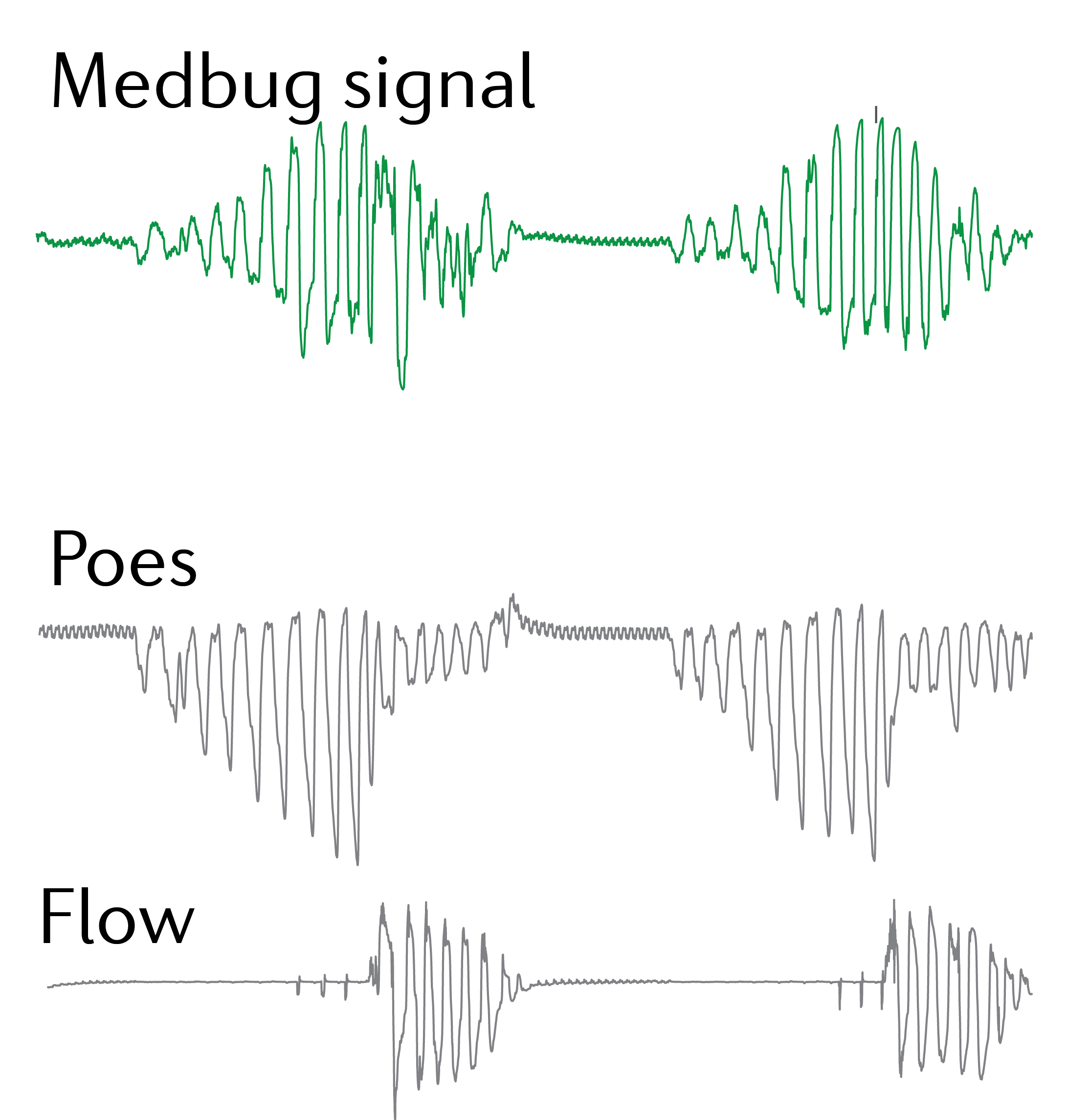
Overnight mattress signal — the continuous trace the model reads to find breathing pauses and build an AHI, without wires on the body.
From mattress signal to research report
A single strip on the mattress reads body motion and breathing as one continuous signal. A deep-learning model turns that overnight trace into second-by-second labels for breathing events, arousals, and sleep — then builds an AHI from those events.
Which events are easiest to catch?
At the individual-event level, distinct signal patterns are easier to separate than subtle ones. Central apnoea — a flat, unmistakable drop in effort — is well recognised; hypopnoea, a smaller partial reduction, is the hardest to pin down and is most often mistaken for normal breathing.
Epoch-level discrimination (AUC)
Severity agreement
Confusion matrix of PSG-diagnosed vs. model-predicted OSA severity category, independent test set (n=29 shown).
| Normal | Mild | Mod. | Severe | |
|---|---|---|---|---|
| Normal | 2 | 4 | ||
| Mild | 1 | 3 | 1 | |
| Mod. | 3 | 2 | 2 | |
| Severe | 11 |
How it ranks
Against published contact-free / under-mattress OSA detectors:
| System | R | MAE |
|---|---|---|
| ZG-S01A ultrawideband radar | 0.97 | — |
| Sonomat piezo mattress | 0.89 | — |
| This study — mattress piezo | 0.94 | 7.3/hr |
| PVDF film mattress array | 0.94 | — |
| Withings under-mattress | — | 9.5/hr |
| SleepMinder radio biomotion | 0.90 | — |
Why it matters
Aggregate AHI can hide event-level detail. Scoring individual apnoea and hypopnoea events — not just a nightly count — preserves more of the overnight pattern for research review.
Known weak spot
Hypopnoea remains genuinely ambiguous from mattress motion alone — 39% read as normal breathing — reflecting the subtlety of the underlying signal, not a modelling shortcut.
What's next
Multi-site, home-based validation; adding acoustic sensing; multi-scorer PSG consensus to sharpen the hardest classes.
Quick answers
What does this system actually score?
Individual breathing events overnight — apnoeas, hypopnoeas, and related disturbances — then summarises them as an AHI compared with expert-scored PSG.
Which events are hardest?
Hypopnoeas. They are partial reductions and look more like normal breathing from mattress motion alone. Central apnoeas — a clearer flat drop — are easier to catch.
Is this a clinical product yet?
These results are research validation against concurrent PSG. They support further study work; they are not a cleared medical device claim for diagnosis or treatment decisions.
Full manuscript: not yet publicly available. This page is a research summary only.
Peer-reviewed link forthcoming