Respiratory arousal threshold: the alarm in your sleep brain
When your airway blocks during sleep, your brain eventually wakes you to reopen it. How much struggle it takes to trigger that wake-up differs a lot between people, and it matters for treatment. Measuring it has meant a tube down the nose. We tested a way to estimate it from a strip under the mattress.
Flinders Health & Medical Research Institute · Flinders University
Think of it as a smoke alarm
In obstructive sleep apnoea the airway keeps narrowing or closing during sleep. The body fights back with bigger and bigger breathing effort, until the brain briefly wakes you and the airway reopens. The respiratory arousal threshold is how much effort it takes to set off that alarm.
1A hair-trigger alarm
A low threshold means you wake at the first sign of trouble, before the airway muscles have had a chance to recover. Sleep gets chopped up. This pattern is found in roughly a third of people with sleep apnoea.
2A slow alarm
A high threshold means breathing effort has to climb a long way before you wake. A high threshold has been linked to metabolic disease and to excessive daytime sleepiness.
It also matters for treatment. Some sedative medicines raise the threshold and, in carefully selected patients, have reduced apnoea severity. Knowing who has a low threshold helps researchers work out who might benefit. It can also change across the night and with treatment, so one snapshot can mislead.
The problem: it’s hard to measure
The reference method uses a thin catheter passed through the nose into the oesophagus to read pressure swings in the chest. It is invasive, labour-intensive and usually done for a single night in a lab. A software method called PUP (Sands et al., 2018) estimates the threshold from a standard sleep study, but it still needs a full lab study with experts scoring every arousal and breathing event by hand.
Sleep apnoea affects close to one billion adults, so that does not scale. We asked whether the mattress sensor could do it with no scoring, nothing on the body, and as many nights as you like.
How it works
The strip under the sheet picks up tiny body movements. An AI model turns them into two second-by-second estimates: how much air is moving and how hard the body is working to breathe. The arousal threshold is then read from the effort level reached just before the brain wakes. We report it as a percentage of normal breathing, where a higher number means a higher threshold.
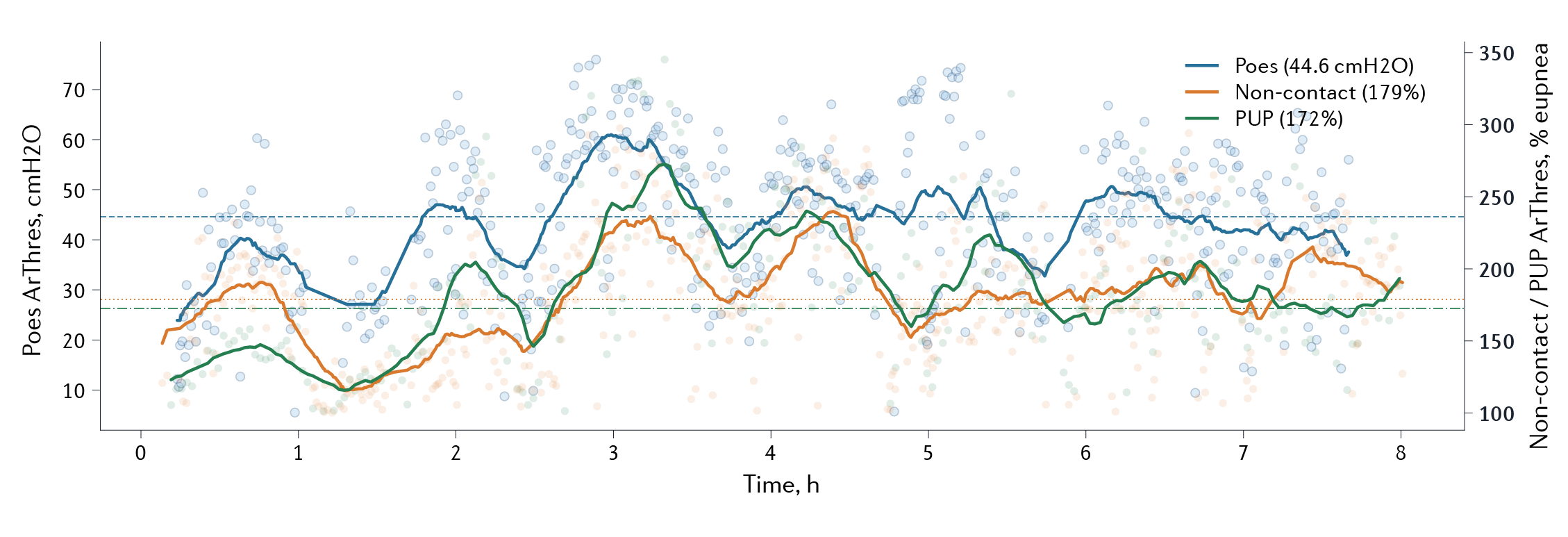
Here is one night from a person with a high threshold. The mattress estimate (orange) and the PUP estimate (green) rise and fall with the invasive pressure reading (blue) across the night.
What we found
1. It follows the gold standard, in a small group
In the 13-person detailed study, the mattress estimate tracked invasive oesophageal pressure closely (r = 0.92), about the same as PUP did on the same nights (r = 0.89). That group is small, and one very high night had a strong influence, so this is encouraging rather than conclusive.
2. It agrees with an established method in new people
On 81 sleep studies the model had never seen, mattress and PUP estimates correlated at 0.82, and 88% of nights fell within 20 points of each other. Sorting nights into low, middle and high thresholds, it got 81% right overall. It was best at spotting low-threshold nights, finding 96% of them, and it never confused low with high.
3. More nights at home make it more reliable
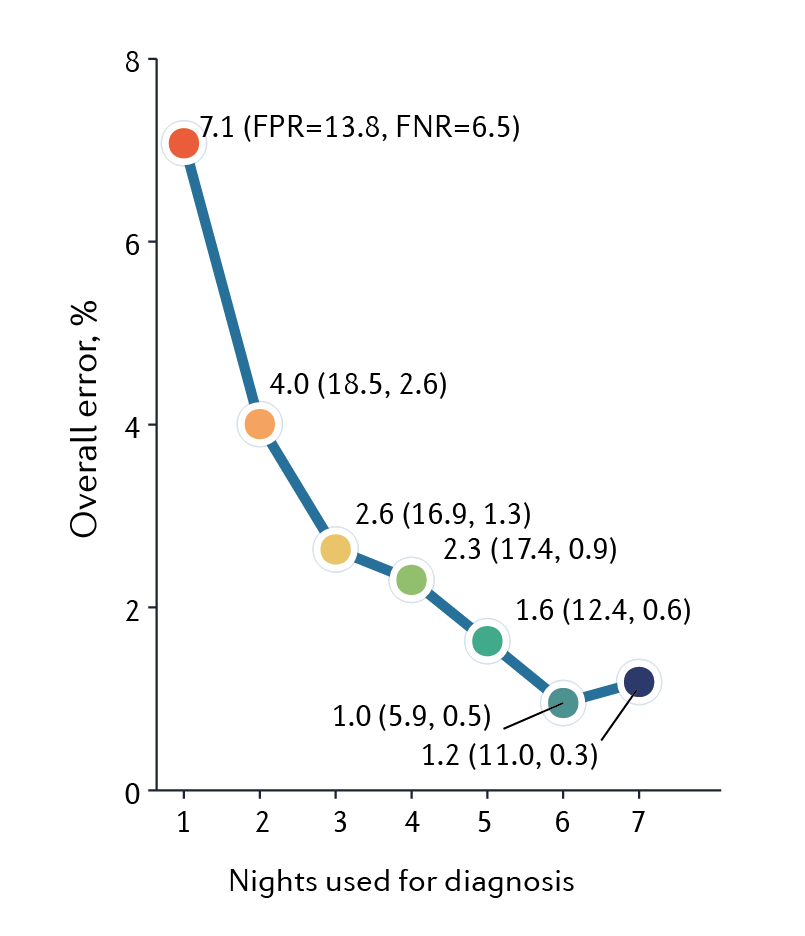
Participants in seven home studies, children and adults, set the sensor up on their own beds with no supervision. A person’s result varies from night to night, so a single night can mislabel them. Using one night disagreed with the long-run result for about 7% of people. That fell to about 3% with three nights and about 1% with six. Repeatability between nights was moderate to good (ICC 0.75).
4. It may pick up change after treatment
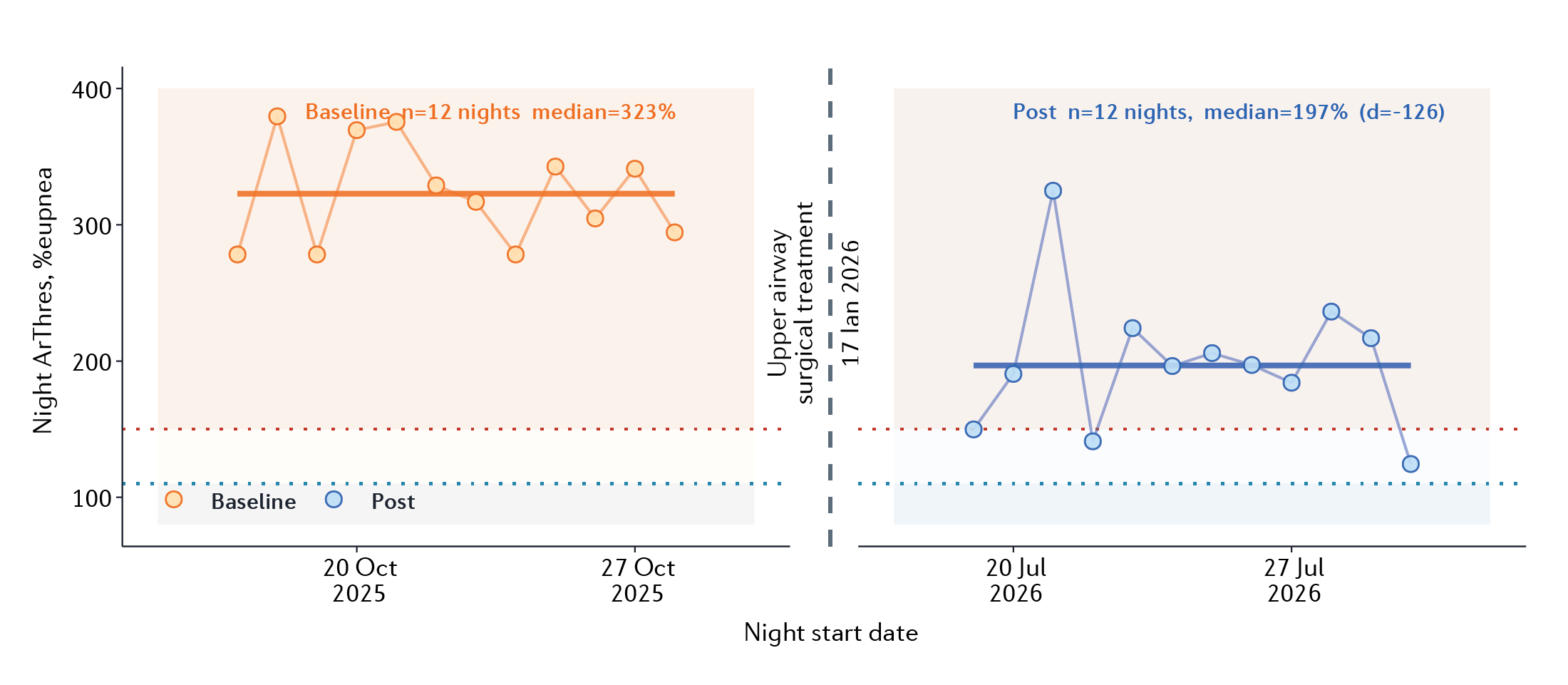
One participant had upper-airway surgery. Their nightly threshold fell from about 320 to about 200, a visible shift in a single person. It is a single case, so it only shows the idea is possible.
What this does not show yet
Most of the comparison is against PUP, which is itself an estimate, and the invasive comparison covers only a small, mostly male group. The low, middle and high cut-points are not firmly established on a mattress scale, and there are no normal reference ranges yet, including for children. The data were collected earlier rather than in a planned trial, and agreement with PUP was not supported in people with near-normal AHI. Night-to-night differences mix real biology with measurement noise, so the multi-night result is a practical compromise, not a pure gold standard.
Three things worth remembering
How hard to wake
The arousal threshold is how much struggle it takes to wake you — it differs a lot between people and may guide treatment choices.
A mattress can estimate it
It tracked an invasive reading and agreed well with an established method, with no scoring and nothing on the body.
Several nights beat one
Averaging nights at home made the result steadier, which a one-night lab study cannot offer.
Flinders Health & Medical Research Institute, Sleep Health · Adelaide, South Australia
Support: Flinders Foundation, Medical Device Research Institute, ANFF, Passe Williams Foundation
Acknowledgement: We thank Professor Scott Sands for permission to use PUP to validate our outputs.
Research-stage summary. Not a medical device.
← Back to Evidence · MedBug home