Loop gain, without a wire in sight
A sensor under the mattress feels your breathing, an AI reads it, and a physiology model turns it into loop gain: how steady your breathing control is, night after night.
Flinders Health & Medical Research Institute · Flinders University
The problem with one night in a lab
Loop gain sounds abstract, but it explains something simple: why breathing pauses in sleep apnoea keep coming back, night after night. It describes how strongly your brain’s breathing control reacts when your breathing changes, and until now, measuring it meant a night in a lab with sensors on your face, chest and body.
Think of a thermostat that overshoots. After a pause, an over-sensitive control system makes you breathe too hard, which drops carbon dioxide too far, which switches breathing off again. A high loop gain keeps that cycle going, and it helps predict who responds to surgery, mouth-guard devices, oxygen and some medicines. But sleep apnoea also changes from night to night, so one lab night can mislead.
Teaching a mattress to estimate it
A thin sensor under the mattress picks up the vibrations of every heartbeat and breath. An AI model, pretrained on a large dataset and then fine-tuned on just 13 adults wearing gold-standard airflow and oesophageal-pressure sensors, turns them into estimates of breathing and breathing effort. A standard physiology model of the body’s breathing control then calculates loop gain from those signals.
The AI never guesses loop gain directly, and nobody has to hand-score breathing pauses or awakenings.
How it works
- One sensor under the mattress feels heartbeat and breathing vibrations
- AI model pretrained on a large dataset, fine-tuned on 13 adults
- Physiology model converts breathing and effort into loop gain
- No wires, no mask, no hand-scoring
One night in the lab
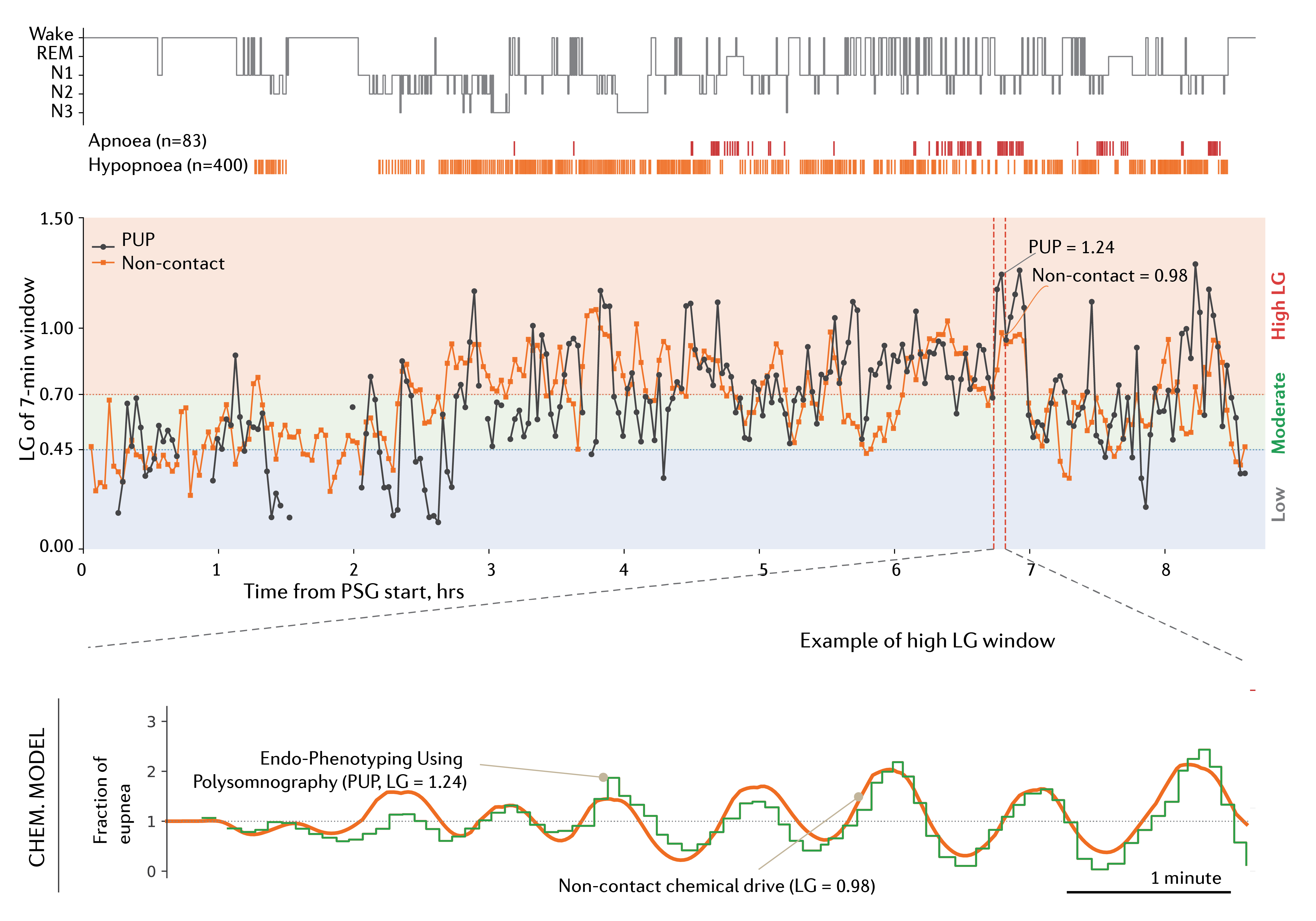
Compared with the standard sleep-study method (called PUP; Terrill et al., 2015; Sands et al., 2018) in 81 independent laboratory studies, the mattress estimates ranked people very similarly (r = 0.86). Sorting everyone into low, moderate or high loop gain, the two methods agreed on 72% of nights and never differed by more than one group.
Then home, for many nights
Tested at home in 64 people, including children, adults with motor neurone disease, and soft, water and air mattresses, about nine in ten main sleep periods gave a usable result. In adults, readings were consistent from night to night, which makes averaging possible.
Compared with a person’s own multi-night average, a single night wrongly flagged 23% of people as moderate or high loop gain at a fixed 10% missed-case rate. More nights fixed most of it:
How it stacks up
Agreement with the standard method for other ways of estimating loop gain without a full lab study:
| Approach | Needs | Result |
|---|---|---|
| This study | Mattress only | r = 0.86 |
| Orr 2018 | Home test sensors | r ≈ 0.47–0.66 |
| Schmickl 2022 | Clinical data | r ≈ 0.48 |
| Dutta 2021 | PSG variables | 40% accuracy (chance = 33%) |
1The cohorts
13 adults to build the model (92% men), 81 independent lab sleep studies to test it, and 64 home participants aged 2 to 80 across seven protocols.
2Open question
The mattress numbers sit on a different scale and agreed on only 2 of 6 high-loop-gain nights, so cut-offs need resetting and direct measurements are needed.
Three things worth remembering
Why it matters
Loop gain could be measured at home over many nights, a step toward matching treatment to the cause of each person’s apnoea.
Mattress agreement
Across 81 lab nights it ranked people similarly to the standard PUP method (r = 0.86), with no wires on the body.
What’s next
Check against direct measurements, set mattress thresholds, and test whether repeated home readings predict treatment response.
Flinders Health & Medical Research Institute, Sleep Health
Full manuscript: not yet peer reviewed. This page is a plain-language research summary only.
Research-stage summary. Not a medical device.
← Back to Evidence · MedBug home