How much of the night is your breathing running on half power?
Sleep apnoea is usually summarised as a count of events per hour. A newer measure asks a different question: for how much of the night is your airflow dangerously low? We tested whether the MedBug SENSE algorithm can answer it, with nothing worn on the body.
Flinders Health & Medical Research Institute · Flinders University
A count tells you how often. Burden tells you how much.
The standard yardstick for sleep apnoea, the apnoea-hypopnoea index (AHI), counts breathing events per hour. Two people can have the same count and very different nights: one has brief shallow breaths, the other spends long stretches barely moving air.
Ventilatory burden (VB) (Parekh et al., 2023) captures that difference. It is the share of sleep time spent with breathing below half of that person's own normal level. It folds depth, duration and frequency into one number, and it also counts reduced breathing that falls short of the formal scoring rules. Research links higher burden to cardiovascular risk, daytime sleepiness and earlier death.
Our idea: let the mattress do the listening
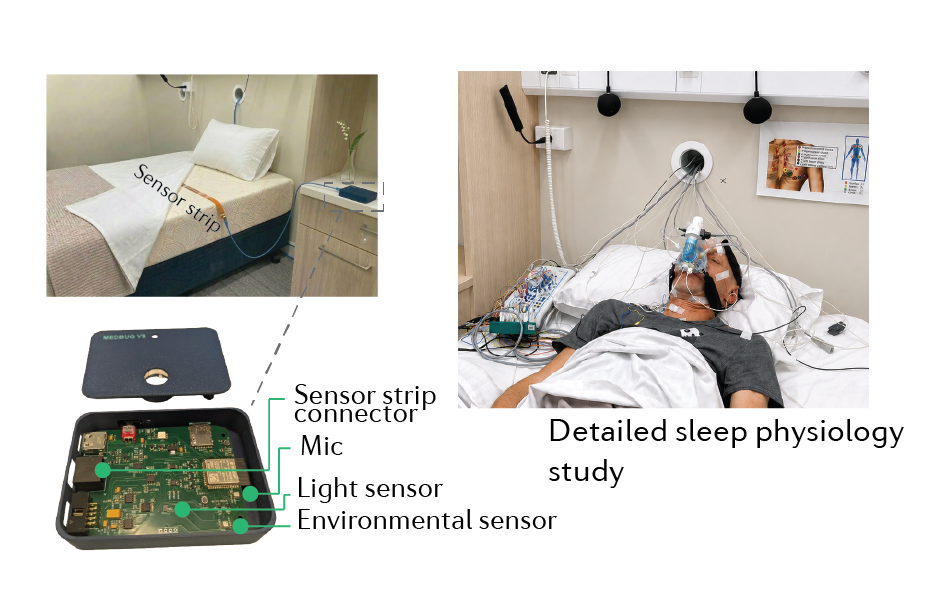
A thin piezoelectric strip under the sheet picks up the tiny movements of breathing. A Transformer deep-learning model, the same family of AI behind modern language tools, turns that signal into a second-by-second estimate of how much air is moving. Burden is then the percentage of sleep time that estimate sits below half of the person's own baseline.
1Build and calibrate
13 adults with suspected sleep apnoea slept with the full research rig: a sealed airflow mask, an oesophageal catheter and the mattress sensor. This gave a gold-standard reference to tune against.
2Test on new people
The method was then run on 81 separate overnight sleep studies it had never seen, and its burden scores were compared with two published nasal-cannula methods (Parekh et al., 2023; Sands et al., 2018).
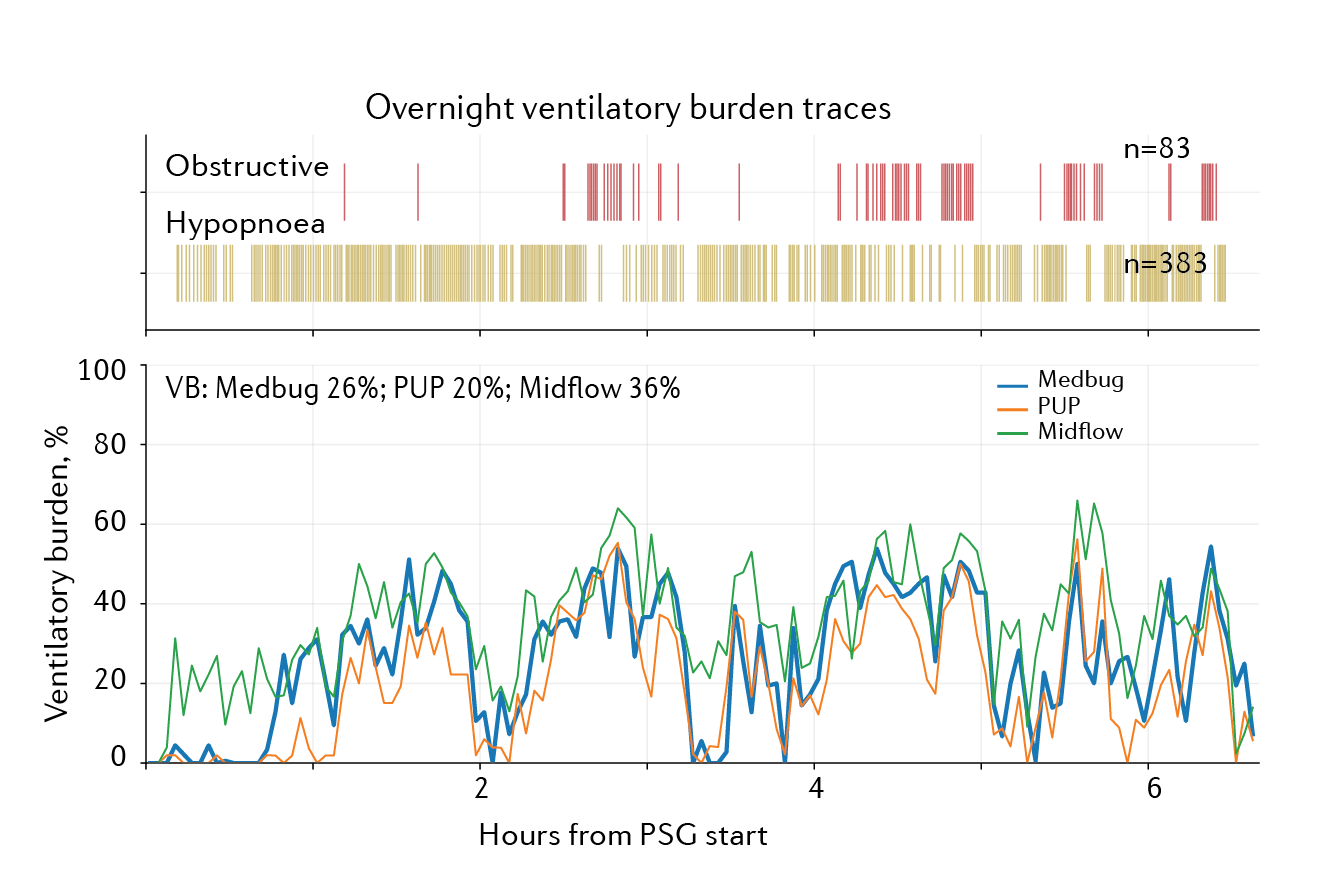
One night, three ways of measuring
Here is a single real night tracked by all three methods. The mattress (blue) rises and falls in step with the two nasal-cannula methods (orange and green), and the clusters of breathing events at the top line up with the high-burden stretches.
How well did it agree on a group of 81 people?
r0.92 vs PUP
Strong correlation with the PUP cannula method, with an average error of 6.8 percentage points.
r0.80 vs Midflow
Good correlation with the Midflow method, with a larger average error of 10.2 points.
What this does not show yet
This was a laboratory study. Burden has not yet been validated on the mattress during unsupervised home sleep, although earlier work showed usable signals can be collected at home. Mattress type, sleeping position and a bed partner's movements could affect accuracy. Nasal cannulas also have flaws of their own, such as with mouth breathing, so agreement with them is not the same as perfect accuracy.
Three things worth remembering
How much, not how often
Burden measures the share of sleep spent with low airflow — linked to heart health and sleepiness.
A mattress can estimate it
Across 81 independent nights it matched established cannula-based methods, with no sensor on the body.
Home validation next
The goal is multi-night monitoring that fits into normal life.
Flinders Health & Medical Research Institute, Sleep Health
Funding: Flinders Foundation, Medical Device Research Institute, ANFF, Passe Williams Foundation
Research-stage summary. Not a medical device.
← Back to Evidence · MedBug home